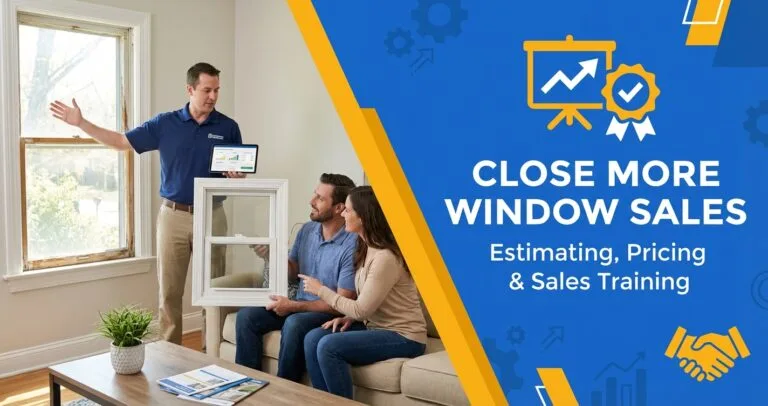
You Generated 47 Leads Last Month. You Closed 8 Jobs. Your Competitor Closed 13 From Fewer Leads. The Gap Is $127,000.
You generated 47 leads last month, ran 28 estimates, and closed 8 jobs at a 28% close rate. The company across town generated 32 leads, ran 22 estimates, and closed 13 jobs at 59%. Same market. Same products. Same manufacturers. Completely different close rates.
The difference is $127,000 in annual revenue.
Not $127,000 in marketing spend. Not $127,000 in new leads. That’s the revenue gap created entirely by what happens after the lead comes in. Your window replacement estimator walks into the same homes, measures the same openings, and quotes the same products. But the company with trained sales reps converts nearly twice as many of those appointments into signed contracts.
At an $11,000 average window job, every single percentage point of close rate improvement is worth $10,000-$15,000 in annual revenue from the same lead volume you already have. You don’t need more leads. You need to stop hemorrhaging the ones you’re already paying for.
Here are 10 sales process improvements that take a window company from a 25% close rate to 45% or higher, without spending a single dollar on additional marketing. If you’re already investing in our window & door marketing program, these sales fixes will multiply every dollar you spend.
Why Window Companies Leak Revenue in the Sales Process
Most window replacement companies obsess over lead generation and ignore the sales process that converts those leads into revenue. That’s like building a bigger funnel while the bottom is full of holes. Three problems bleed you dry:
Problem 1: Speed Kills You (The Slow Kind). Your window replacement estimator gets the lead notification, finishes the current job, grabs lunch, and calls back 4 hours later. By then, the homeowner has already scheduled estimates with two competitors. Research from Lead Connect shows that responding within 5 minutes makes you 21x more likely to qualify the lead than waiting 30 minutes. Most window companies respond in 2-4 hours. That delay alone costs you 30-40% of your leads before a single estimate is run.
Problem 2: Your Estimators Are Measurers, Not Closers. You promoted your best installer to “estimator” because he knows the product. He walks in, measures windows, writes a quote, hands it over, and says “let me know.” No presentation structure. No value framing. No close. He’s a tape measure with a truck. Untrained reps close 15-20% of in-home estimates. Trained reps close 35-45%. That gap is the difference between a $600K company and a $1.4M company running the same lead volume.
Problem 3: You Have No Follow-Up System. 80% of sales happen between the 5th and 12th contact. Your estimator follows up once, maybe twice, then moves on to the next estimate. The homeowner who said “we need to think about it” was genuinely interested but needed time to discuss it with their spouse, check their home equity line, or get one more quote. They were a yes waiting to happen. Instead, your competitor called them back on day 3, day 7, and day 14. Your competitor closed the job.
The window companies doing $2M+ in annual revenue from the same market you serve aren’t buying better leads. They’re extracting more revenue from every lead they touch. At Home Service Direct, we see this pattern across every market we serve: the companies that invest in sales training outperform higher-spending competitors every single time. That’s a sales process problem, and sales process problems are fixable. Here’s how.
10 Window Sales Training and Estimating Improvements That Double Your Close Rate
1. Speed-to-Lead: Call Within 5 Minutes or Lose the Job
Speed-to-lead is the single highest-ROI change you can make to your sales process. It costs nothing and produces immediate results.
What It Is: A system that ensures every new lead gets a live phone call within 5 minutes of submission, regardless of time of day or what your team is doing.
Why It Works: Harvard Business Review found that companies responding within 5 minutes are 5x more likely to make contact and 21x more likely to qualify the lead compared to a 30-minute response. For window replacement, where homeowners typically request 3-5 estimates simultaneously, the first company to call gets the first appointment. The first appointment closes at 35-50% higher rates than the third or fourth appointment because the homeowner hasn’t developed “estimate fatigue” yet.
Implementation Steps:
- Set up instant lead notifications via text and email to your sales rep’s phone, not just a CRM inbox
- Assign lead response as the #1 priority over everything else, including in-progress estimates
- If your estimator can’t answer during a job, hire a dedicated appointment setter for $15-$20/hour who does nothing but answer leads and book consultations
- Use an auto-text system (Hatch, Podium, or even a simple Zapier automation) that sends “Hi [name], this is [your company]. We just received your window estimate request. I’m calling you now.” within 60 seconds
- Track response time for every lead in your CRM and review weekly
Budget: $0 (process change) to $2,500-$3,500/month (dedicated appointment setter)
Expected Impact: 25-40% increase in appointment-set rate from the same lead volume
ROI: At 30 additional appointments/year and a 35% close rate, that’s 10+ extra jobs at $11,000 = $110,000+ in additional annual revenue
The companies generating the most revenue from their window and door lead sources aren’t buying more leads. They’re answering faster.
2. Pre-Qualification Scripts: Stop Running Estimates for Tire-Kickers
Running an in-home estimate costs you $150-$300 in labor, fuel, and opportunity cost. Every unqualified estimate you run is money you lit on fire.
What It Is: A structured phone script that qualifies leads before you send an estimator to their home. Five questions that take 3 minutes and save you hours of wasted windshield time.
Why It Works: Window companies that pre-qualify leads report 20-30% fewer wasted estimates. That means your estimator runs fewer appointments but closes a higher percentage, because every home they walk into has a qualified buyer. At $200 per estimate cost and 15 wasted estimates per month eliminated, that’s $3,000/month saved in direct costs alone.
Implementation Steps:
- Ask about timeline: “When are you looking to get this done?” (Eliminate “just browsing” and “maybe next year”)
- Ask about scope: “How many windows are you considering?” (Single-window jobs under $1,500 may not be worth an in-home visit)
- Ask about budget awareness: “Most whole-home window replacements in our area run $8,000-$15,000 depending on specifications. Does that align with what you’re expecting?” (Eliminate sticker-shock cancellations)
- Ask about decision-makers: “Will all decision-makers be present for the consultation?” (This alone eliminates 20-30% of “we need to talk it over” stalls)
- Ask about other estimates: “Have you gotten other quotes yet?” (Helps your estimator calibrate their presentation)
Budget: $0 (script development and training)
Expected Impact: 20-30% reduction in wasted estimates, 10-15% increase in close rate on remaining appointments
ROI: $36,000-$54,000/year in recovered estimate costs plus higher conversion on qualified appointments
3. The 45-Minute In-Home Consultation Framework
Your estimator walks in, measures, writes a number on paper, and leaves. The top-performing window companies run a structured 45-minute consultation that educates the homeowner, builds value, and positions the close. The difference is 15-20 percentage points of close rate.
What It Is: A repeatable in-home presentation structure that every estimator follows on every appointment. Not a rigid script. A framework with specific phases, talking points, and visual aids.
Why It Works: Window replacement is a high-consideration, high-anxiety purchase. Homeowners are spending $8,000-$15,000 on something they buy once every 20-30 years. They don’t know what makes one window better than another. They don’t understand U-factors, SHGC ratings, or argon gas fills. The estimator who educates them wins. Trained window sales reps using a structured presentation close at 35-45% versus 15-20% for untrained reps.
Implementation Steps:
- Phase 1 (5 min): Rapport and discovery. Ask about why they’re considering new windows. Energy bills? Drafts? Aesthetics? Noise? Their answer determines your entire presentation angle.
- Phase 2 (10 min): Home walkthrough. Inspect existing windows together. Point out specific problems: failed seals (foggy glass), broken balances, air infiltration. Let the homeowner see and feel the problems.
- Phase 3 (15 min): Education and product demo. Show window cross-sections or samples. Explain the difference between vinyl, fiberglass, and wood. Use a thermal camera app on your phone to show heat loss through current windows. Tie every feature to their specific concern.
- Phase 4 (10 min): Measurement and options. Measure all windows. Present three options (see Strategy 5 below). Walk through each option and what the homeowner gets at each level.
- Phase 5 (5 min): Close. Summarize their problem, your solution, and the investment. Ask for the business.
Budget: $2,000-$5,000 (one-time training investment: window samples, sales binders, thermal camera)
Expected Impact: 15-20 percentage point increase in close rate for estimators using the framework
ROI: At 200 estimates/year and a 15-point close rate increase on $11,000 average jobs, that’s $330,000 in additional annual revenue from a one-time $5,000 investment. That’s a 66x return.
4. Value-Based Pricing vs. Cost-Plus: Charge What the Job Is Worth
Most window companies price jobs using cost-plus: materials + labor + 30-40% margin. That’s a recipe for leaving money on the table on premium jobs and losing jobs on budget-sensitive ones.
What It Is: A pricing strategy where your estimate reflects the value the homeowner receives (energy savings, comfort, aesthetics, home value increase) rather than just your costs plus a fixed margin.
Why It Works: A homeowner in a $600,000 house replacing 20 windows perceives value differently than a homeowner in a $200,000 house replacing 6 windows. The first homeowner will spend $18,000-$25,000 without hesitation if you frame the investment in terms of home value protection and energy savings. Cost-plus pricing gives them a number. Value-based pricing gives them a justification for that number. Window companies that switch to value-based pricing report 12-18% higher average ticket values with no decrease in close rate.
Implementation Steps:
- Research energy savings data for your climate zone (EnergyStar.gov provides regional estimates by window type)
- Calculate ROI talking points: “These windows will save you $480-$720/year on energy. Over their 25-year lifespan, that’s $12,000-$18,000 in savings.”
- Build a “home value” talking point: “New windows return 68-73% of their cost in increased home value at resale according to Remodeling Magazine’s Cost vs. Value report.”
- Adjust pricing by neighborhood: higher-value homes get value-based pricing, budget-conscious markets get cost-plus with clear scope definitions
- Train estimators to present cost-per-window rather than total project cost: “$485 per window” feels different than “$9,700 for 20 windows”
Budget: $0 (pricing strategy change)
Expected Impact: 12-18% increase in average job value, maintaining or improving close rate
ROI: On $1M in annual revenue, a 15% ticket increase = $150,000 in additional revenue with zero additional lead cost
Understanding your profit margins on window replacement jobs is the foundation for building a pricing strategy that doesn’t leave money on the table.
5. The Good-Better-Best Three-Option Estimate
Presenting one price gives the homeowner a binary decision: yes or no. Presenting three options gives them a choice between levels. 60-70% of homeowners choose the middle option. Make the middle option your target price.
What It Is: Every window replacement estimator presents three clearly defined packages: Good (entry-level), Better (your sweet spot), and Best (premium). Each option has specific product differences, feature differences, and warranty differences.
Why It Works: Behavioral economics. When presented with three options, buyers anchor against the highest price, making the middle option feel reasonable. A homeowner who would have said “too expensive” to a $12,000 single quote will choose the $12,000 “Better” package when it sits between an $8,500 “Good” package and a $16,500 “Best” package. Companies using good-better-best report 15-25% higher average ticket values and a 5-10% improvement in close rate because “no” becomes less common when the homeowner has options.
Implementation Steps:
- Define three tiers with meaningful product differences (not just price padding). Example: Good = vinyl double-pane; Better = vinyl triple-pane with Low-E; Best = fiberglass triple-pane with Low-E and argon fill
- Make the “Better” option your target margin. Price it where you want to land on most jobs
- Include different warranty levels: Good = manufacturer warranty only; Better = 10-year labor warranty; Best = lifetime labor + transferable warranty
- Present all three on a single page, side by side, with features highlighted in a clear comparison layout
- Always present Best first, then Better, then Good. Anchoring the highest price first makes the middle feel like a deal
Budget: $500-$1,000 (professional estimate templates and presentation materials)
Expected Impact: 15-25% increase in average ticket, 5-10% improvement in close rate
ROI: On 100 annual jobs at $11,000 average, a 20% ticket increase = $220,000 in additional annual revenue
6. Handling Price Objections Without Discounting
When a homeowner says “that’s more than I expected,” most estimators panic and start cutting scope or offering discounts. Every dollar you discount comes directly out of your profit margin. A 10% discount on a $12,000 job costs you $1,200 in pure profit. Do that 50 times a year and you’ve given away $60,000.
What It Is: A set of trained responses to price objections that reframe the conversation around value, payment options, and long-term cost without lowering the price.
Why It Works: Price objections are rarely about the price. They’re about uncertainty. The homeowner isn’t sure the investment is worth it. Discounting confirms their suspicion that you were overcharging. Value reframing confirms that the price reflects real quality. Companies that train their reps in objection handling report fewer discounts given, higher average margins, and counterintuitively, higher close rates because confidence sells.
Implementation Steps:
- “I understand. Let me show you the cost breakdown.” Transparency kills suspicion. Show material costs, labor, warranty, and margin. Homeowners respect honesty.
- “What were you expecting to invest?” This shifts the conversation from your price to their budget. Often their number isn’t far from yours, and you can adjust scope rather than price.
- “Over 25 years, this investment costs $1.47 per day per window.” Reframe the total into daily cost. $12,000 sounds painful. $1.47/day sounds trivial.
- Offer financing. 12-month same-as-cash or 60-month low-interest financing turns a $12,000 objection into a $200/month conversation. Partner with GreenSky, Service Finance, or Foundation Finance.
- Never offer a discount unprompted. If you must adjust, remove scope (fewer windows, different product tier) rather than cutting price on the same scope.
Budget: $0 (training and role-playing)
Expected Impact: 5-8% higher average margin, 3-5% improvement in close rate
ROI: Eliminating $60,000 in annual unnecessary discounts goes straight to your bottom line
7. Same-Day Close Techniques: Ethical Urgency Creation
Every day between the estimate and the decision is a day the homeowner can get cold feet, get another quote, or decide to “wait until next year.” The one-call close is the most profitable close in window sales, and trained reps achieve it on 35-45% of appointments versus 15-20% for reps who leave and hope for a callback.
What It Is: A set of legitimate reasons for the homeowner to make their decision today, presented honestly and without high-pressure manipulation.
Why It Works: Window replacement is an emotional purchase disguised as a practical one. The homeowner is most emotionally invested immediately after seeing their failing windows, hearing the energy savings numbers, and visualizing their home with new windows. Tomorrow, that emotion fades. Next week, it’s gone. Ethical urgency captures the decision when the motivation is highest.
Implementation Steps:
- Installation scheduling: “We’re booking 3-4 weeks out right now. If you’d like to get on the schedule for [specific date], I can lock that in today.” Real scarcity, not manufactured.
- Material pricing: “Vinyl resin costs have increased 8% this quarter. I can hold this price for 7 days, but I can’t guarantee it beyond that.” Only use this when material costs are genuinely volatile.
- Seasonal timing: “Spring is our busiest season. Homeowners who commit now get priority scheduling before our March-May rush.”
- Same-day incentive: Offer a legitimate value-add (not a discount) for same-day decisions: free window cleaning for a year, upgraded hardware package, or extended labor warranty. The add-on costs you $200-$400 but saves the deal.
- Never use fake deadlines, phantom discounts, or “my manager will only approve this today” tactics. Homeowners see through them. Your reputation is worth more than one close.
Budget: $200-$400 per same-day incentive add-on
Expected Impact: 15-25% increase in same-day close rate, 30-40% reduction in estimate-to-close cycle time
ROI: Each same-day close eliminates 2-3 follow-up visits ($150-$300 each) and reduces the chance of losing the deal to a competitor by 60-70%
8. The 7-Touch Follow-Up Sequence for Unsold Estimates
80% of sales happen between the 5th and 12th contact. Most window estimators give up after 1-2 follow-ups. That means you’re abandoning 80% of your potential closes because nobody picked up the phone a third time.
What It Is: A structured, multi-channel follow-up sequence that contacts unsold estimates 7 times over 30 days using phone, text, and email.
Why It Works: The homeowner who said “we need to think about it” wasn’t lying. They genuinely need time. But if you disappear, they assume you don’t care. The company that stays in touch professionally, without being pushy, gets the call back. Companies with systematic follow-up sequences close an additional 15-25% of previously unsold estimates. At an $11,000 average job, recovering just 3 lost deals per month from follow-up adds $396,000 in annual revenue.
Implementation Steps:
- Day 1: Thank-you text and email within 2 hours of leaving. Include a recap of the three options discussed and your direct phone number.
- Day 3: Phone call. “Hi [name], just following up on the window consultation. Do you have any questions I can answer?”
- Day 7: Email with a relevant resource: energy savings calculator, before-and-after gallery, financing options breakdown.
- Day 10: Text message. Keep it casual: “Hey [name], wanted to check in. Still happy to answer any questions about the windows.”
- Day 14: Phone call with a soft deadline: “Our installation schedule is filling up for [month]. Want me to pencil you in?”
- Day 21: Email with a case study or review from a homeowner in their area.
- Day 30: Final call. “I wanted to reach out one last time. If the timing isn’t right, no problem at all. We’d love to help whenever you’re ready.”
Budget: $50-$200/month (CRM automation: Jobber, ServiceTitan, or HubSpot)
Expected Impact: 15-25% close rate on previously unsold estimates
ROI: Recovering 3 lost deals/month x $11,000 = $396,000 in annual revenue from leads you already paid for
Of course, follow-up only works when you have a consistent pipeline to follow up on. Building a steady flow of qualified window replacement customers is the other half of the equation.
9. Review and Referral Request Process Built Into Every Close
Every closed job is a marketing opportunity. The problem is that most window companies ask for reviews and referrals randomly, inconsistently, or never. Systematize it.
What It Is: A built-in step at the end of every completed installation where the crew leader triggers an automated review request, the office sends a referral kit, and the homeowner becomes a marketing asset instead of just a completed invoice.
Why It Works: Window companies with 100+ Google reviews generate 3-5x more organic calls from their Google Business Profile than companies with 15-20 reviews. Every review improves your local SEO rankings, your click-through rate, and your close rate on future estimates. Referred leads close at 50-70% compared to 25-35% for cold leads. One systematic referral process generates a compounding return for years.
Implementation Steps:
- Crew leader does a final walkthrough with the homeowner on completion day. If the homeowner is happy, the crew leader says: “We’d really appreciate a Google review. You’ll get a text in about an hour with a direct link.”
- Automated text/email goes out 2 hours post-installation with a direct Google review link (one tap to leave a review)
- Second review request goes out 3 days later if no review was left
- Referral card or door hanger left at the home: “$250 gift card for every neighbor you refer who books with us”
- 30 days post-installation: email with a referral link and seasonal promotion to share with neighbors
- Drop 20-30 door hangers on neighboring houses within 48 hours of installation: “Your neighbor at [address] just upgraded their windows. Free estimates for the neighborhood.”
Budget: $100-$300/month (review software) + $250 per closed referral (only paid on revenue)
Expected Impact: 8-15 new reviews/month, 3-8 referral leads/month
ROI: Referral leads at 60% close rate and $11,000 average job: 5 referral closes/month = $660,000 in additional annual revenue
Reviews and referrals also reduce your cost per lead for window replacement because organic leads cost you nothing to acquire.
10. Sales Tracking and KPI Dashboards: What Gets Measured Gets Managed
If you can’t tell me your close rate by estimator, by lead source, and by month, you’re guessing. And window companies that guess about their sales process leave $200,000-$500,000 on the table annually.
What It Is: A weekly dashboard that tracks every metric in your sales process from lead to close, broken down by individual rep and lead source.
Why It Works: You can’t improve what you don’t measure. When you track close rates by rep, you discover that one estimator closes at 42% and another at 19%. That’s not a lead quality problem. That’s a training problem with a specific, identifiable solution. Companies that implement sales tracking and weekly reviews see 10-20% improvements in close rate within the first 90 days because visibility creates accountability.
Implementation Steps:
- Track these KPIs weekly: leads received, speed-to-lead time, appointments set, appointments run, estimates presented, same-day closes, follow-up closes, lost deals, close rate by rep, close rate by lead source, average ticket by rep, revenue per lead
- Build a simple dashboard in Google Sheets, ServiceTitan, or your CRM. It doesn’t need to be complicated. It needs to be visible.
- Hold a 30-minute weekly sales meeting where you review the numbers as a team. No blame. Just data.
- Identify the top performer and document what they do differently. Then train the rest of the team on those specific behaviors.
- Set monthly targets: close rate, average ticket, revenue per lead. Tie bonuses to hitting those numbers.
Budget: $0-$200/month (CRM or dashboard tools)
Expected Impact: 10-20% improvement in overall close rate within 90 days
ROI: On 500 annual estimates at $11,000 average, a 10% close rate improvement = $550,000 in additional annual revenue
Running Google Ads for your window company becomes dramatically more profitable when your sales process converts at 40%+ instead of 25%.
Your 30-Day Sales Improvement Plan
Don’t try to overhaul everything at once. That’s how you overwhelm your team and nothing sticks. Here’s the week-by-week rollout that actually works:
Week 1: Speed and Qualification
- Implement 5-minute speed-to-lead response for every new lead starting Monday
- Write and distribute pre-qualification scripts to everyone who touches inbound calls
- Set up instant lead notifications on your sales reps’ phones
- Start tracking response time for every lead in a shared spreadsheet or CRM
- Role-play the qualification script 3 times with each rep
Week 2: Presentation and Pricing
- Build your good-better-best estimate template with three clearly differentiated tiers
- Write the 45-minute consultation framework on a single page. Laminate it. Put it in every estimator’s truck.
- Order window samples and a thermal camera for the product demo phase
- Practice the full 45-minute presentation 3 times with role-playing (have someone play a skeptical homeowner)
- Develop your value-based pricing talking points: energy savings, home value, daily cost reframing
Week 3: Objection Handling and Closing
- Train objection handling responses: run through the 5 most common objections and rehearse responses
- Develop same-day close incentives that add value without discounting (extended warranty, free hardware upgrade)
- Set up financing through at least one partner (GreenSky, Service Finance, or Foundation Finance)
- Practice the close sequence: summarize problem, present solution, ask for the business
- Create a “do not discount” policy with specific alternatives reps can offer instead
Week 4: Follow-Up and Measurement
- Build and automate the 7-touch follow-up sequence in your CRM or a simple spreadsheet
- Launch automated review request system (Podium, NiceJob, or Birdeye)
- Create the referral program: print referral cards, write the neighbor door-hanger, set the reward amount
- Build your KPI dashboard and hold your first weekly sales meeting
- Review Week 1-3 results: compare this month’s close rate to last month’s as your baseline
Expected results by Day 30: Your close rate should improve by 5-10 percentage points from speed-to-lead and pre-qualification alone. That’s the low-hanging fruit. The full 15-20 point improvement to the 40-45% range takes 60-90 days as your team internalizes the presentation framework and objection handling. At your current lead volume, that close rate improvement is worth $150,000-$300,000 in annual revenue.
5 Critical Sales Mistakes Costing Window Companies $50,000-$200,000 Per Year
Mistake 1: Sending Installers to Do a Salesperson’s Job
Your best installer knows everything about windows and nothing about selling them. He measures, quotes, and leaves. He doesn’t build rapport, educate the homeowner, or ask for the business. His close rate sits at 15-20% while a trained sales rep running the same leads closes 35-45%. On 200 estimates per year, that gap is 40-50 lost jobs at $11,000 each. Annual cost: $440,000-$550,000.
The fix: Either train your estimators in sales methodology (invest $2,000-$5,000 in window sales training) or hire a dedicated salesperson and keep your installers on the tools where they belong.
Mistake 2: Presenting One Price and Hoping for the Best
A single price turns the conversation into yes or no. A three-option estimate turns it into which one. Companies using good-better-best report 15-25% higher average tickets and 5-10% higher close rates. On 100 jobs per year, a 20% ticket increase on an $11,000 average job equals $220,000 in additional annual revenue. You’re leaving that on the table every time your estimator writes one number on a piece of paper.
The fix: Build three-tier estimate templates this week. Train every estimator to present all three options on every appointment starting next Monday.
Mistake 3: No Follow-Up System After the Estimate
The homeowner said “we’ll think about it.” Your estimator called once, got voicemail, and moved on. Meanwhile, 80% of sales happen between the 5th and 12th contact. You didn’t lose that deal to a competitor’s lower price. You lost it to their persistence. On 10 recoverable deals per month at $11,000 each, zero follow-up costs you $1,320,000 annually in winnable revenue.
The fix: Build the 7-touch follow-up sequence. Automate it. Make it non-optional for every unsold estimate.
Mistake 4: Discounting Instead of Reframing
Every time an estimator drops the price $500-$1,500 to “make the deal work,” that money comes straight from your profit. At a 40% gross margin, a $1,000 discount costs you $1,000 in profit (you already committed to the materials and labor). Fifty discounted jobs per year at $1,000 average discount = $50,000 gone from your bottom line.
The fix: Train objection handling. Offer financing, scope adjustments, or value-add incentives. Never reduce price on the same scope of work.
Mistake 5: Not Tracking Sales Metrics by Individual Rep
You have two estimators. One closes at 42%. The other closes at 22%. You don’t know this because you don’t track by rep. You’re averaging them at 32% and blaming “lead quality” for the shortfall. Meanwhile, Rep B is costing you 20 lost jobs per year at $11,000 each = $220,000 in annual revenue that Rep A would have closed from the same leads.
The fix: Track close rate, average ticket, and revenue per lead by individual estimator. Review weekly. Train to the gap.
How Home Service Direct Fills Your Pipeline So You Can Focus on Closing
You now have a complete window sales training system that can double your close rate. But close rate improvements only matter if you have a steady pipeline of qualified leads to run through that system.
- Exclusive window and door leads delivered only to your company. No shared leads, no competing with 4 other companies for the same homeowner. Our clients close at 30-45% on exclusive leads versus 8-15% on shared platforms.
- Comprehensive marketing management across Google, Facebook, and local SEO channels. We manage the lead generation infrastructure so your team can focus entirely on converting appointments into revenue.
- SEO that compounds over time. Our local SEO strategies for window companies build organic lead flow that costs $0 per lead once it’s established.
- Multi-channel lead flow from Facebook ads, Google Ads, and local search so your pipeline stays full through every season.
The best sales process in the world produces nothing without leads to feed it. Talk to our team about building a lead generation system that keeps your estimators booked solid.
Looking to diversify your revenue streams beyond residential? Our guide to commercial window replacement leads covers a market segment most residential companies completely ignore.
Your Close Rate Is the Highest-Leverage Number in Your Business
You can spend $10,000 more per month on marketing and add 30-50 leads to your pipeline. Or you can spend $5,000 once on sales process improvements and close 15-20 more jobs from the leads you already have.
The math is not close.
A 25% close rate on 200 annual estimates at $11,000 average produces $550,000 in revenue. A 45% close rate on the same 200 estimates produces $990,000. Same leads. Same marketing budget. Same estimators driving the same trucks to the same homes. The only difference is what happens in the living room.
Every strategy in this guide is implementable within 30 days. The 5-minute speed-to-lead response takes 10 minutes to set up. The pre-qualification script takes an afternoon to write. The three-option estimate template takes a morning to build. None of this is complicated. All of it is profitable.
The window companies doing $2M+ aren’t smarter than you. They’re not luckier. They trained their sales team, built a repeatable process, and measured the results. That’s it.
You now have the exact same playbook they used to get there. The question is whether you’ll implement it this week or add it to the pile of good ideas you never acted on.
Your competitor already chose. What about you?